Novità
News
Nouveautés
autés
Back to the top




Kirkus Reviews - February 15, 2011
Pfister's latest book is a sweetly simple
look at some very deep questions, allo-
wing children the opportunity to delve
into some of life's mysteries.
The questions, each presented as a
rhyming couplet, could have been just as
easily formulated by a child as by
the author – they feel like the charming
queries children seem to make when
adults least expect them. Although
readers will find no answers here, most
have scientific explanations, but others
certainly hint toward the divine. And while
the text is well written (translated from
German), it is the beautiful artwork that
will draw readers back for more.
Luminous colors and amazing textures
stand out against the stark, white
backgrounds. While new to Pfister, the
technique suits the tone of the text to a T.
Each element was cut from thick
cardboard, then painted with acrylics and
stamped onto paper to complete the
individual scenes. The result echoes the
mix of simplicity and complexity in-herent
in each question.
In a world that so often emphasizes
answers and solid facts, it is refreshing to
see a text that encourages question-ing,
whether realistic or imaginative flights of
fancy. (Picture book. 3-7)
Publisher’s Weekly - January 2011
In an age when infinite answers are
available in an instant, maybe the
questions we ask are what matter most.
“There’s so much that I want to know,”
writes Pfister, and in 13 short couplets
he shows readers how questioning is a
genuinely creative act – a way of being
fully engaged in the world. His verses
are by turns fanciful (“Do apple seeds
dream happily/ of growing up to be a
tree?”), scientifically minded (“What turns
the leaves from green to brown/ and
sends them floating gently down?”), and
even fath based (“Who teaches
butterflies to fly/ splashing their colors
through the sky?”). In a depar-ture from
his Rainbow Fish series, Pfister has
created images as pity as they are
poignant, boldly graphic and dramatically
cropped against white backgrounds. A
blue-headed songbird is reminiscent of
Asian watercolour; a storm cloud looks
like it’s been fashio-ned from salt dough;
falling leaves seem cut from pieces of
thickly tufted carpet. Altough each was
created using the same painted paper
method (Ex-plained in the final page),
the results are as varied as the
questions.
Ages 3-up. (Mar.)
Midwest Book Review (Karyn's
Bookshelf) - March 2011
Bold Crayola hues beckon from the
cover of Swiss author and illustrator
Marcus Pfister's newest work. Inside a
color explosion continues, from amber
autumn leaves to angry charcoal blue
storm clouds to orange and purple
butterflies. But it's not just the color that
awes. Pfister's experimentation with
texture - applying acrylic paint to
cardboard and then thickly stamping it
onto paper -- results in page after page
of enticing composition. And the poem-
based text ponders nature's mysteries
in a wonderfully childfriendly cadence.
"Does a whale make up a song so other
whales will sing along?" it ponders. And
"do apple seeds dream happily of
growing up to be a tree?" Migrating
geese, sea shells and fire are among
the topics.
Originally published in Switzerland
and recently translated into English,
"Questions, Questions" is a rare,
near perfect symphony of art and
words, a new treasure that once
again cements Pfister as a formi-
dable writer and artist of our time.
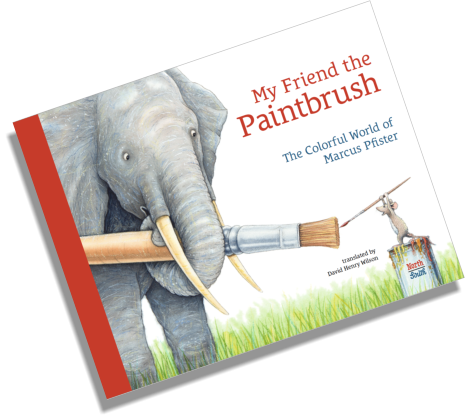
Booklist: My Friend the Paintbrush got a starred review!
In this unique, interestingly straightforward picture book, celebrated
artist Pfister addresses readers directly, using rhymed couplets to explain
how he uses his paintbrushes to bring his beloved characters to life.
Audiences will readily recognize Rainbow Fish and Penguin Pete and be
treated to a retrospective of Pfister’s additional work, highlighting 17
titles produced over the past 30 years. Effortlessly translated from the
original German, the first half of the book talks about “my friend” and its
amazing capabilities. Pfister’s friend—his paintbrush—can be smooth or
rough, clumsy or graceful, and use black and white or be full of color
(each statement supplemented by an illustration demonstrating various
painting styles), but it must always be held by hand and never be digital.
The second half highlights selected excerpts from Pfister’s books and
offers brief comments about how and why he incorporated special
techniques into specific illustrations. Examples include the foil stamping
in The Rainbow Fish, the split pages in his Milo series, and the fabric
backgrounds in Bertie at Bedtime. In his closing comments, Pfister
expresses his hope that readers
will discover their own creative innovations. This cheerful offering work
equally well as a read-aloud or basic art tutorial and will intrigue
picture-book enthusiasts of all ages.
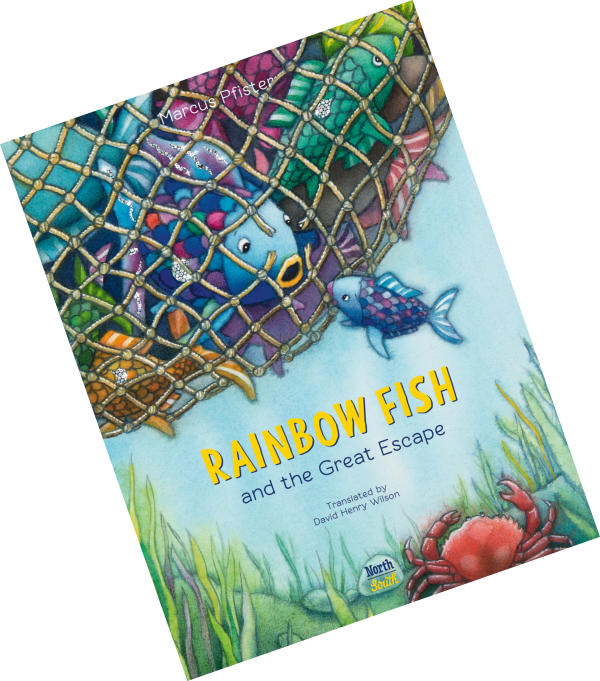
33 years of Rainbow Fish and its 10th title
The tenth book in the New York Times bestselling Rainbow Fish
series encourages care and respect for the ocean and its
creatures.
Rainbow Fish and his friends have only ever heard stories
about the nets that come through and take away shoals of fish
from the ocean. Luckily, they’ve never had to experience that
danger for themselves. All is peaceful until one day, Rainbow
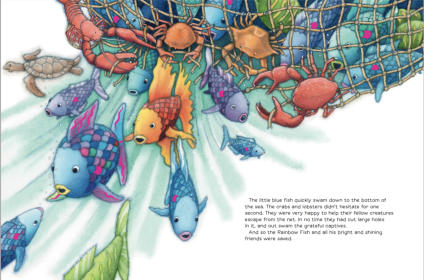
Fish and his friends come face to face with the trawling net.
Even though getting caught within the net is scary, Rainbow
Fish and his friends are quick to act. With the help of crabs and
lobsters nearby, they’re able to cut through the net and help
everyone trapped within make their great escape.
This thrilling addition is a perfect example of quick problem
solving and how to lean on one’s community in difficult
situations.
Reviews of “Questions, questions”, 2011
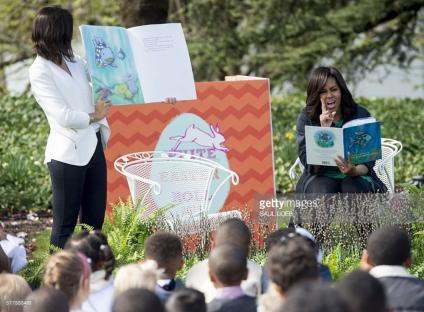
Goodbye Michelle and Barack!
A memory to savour of he outgoing US President. Michelle and
Barack Obama reading the Rainbow Fish at the White House Eas-
ter Egg Roll in 2016. Thanks for everything!